The Portal · Equipment
Record Through a Focusrite Scarlett 18i16 in London
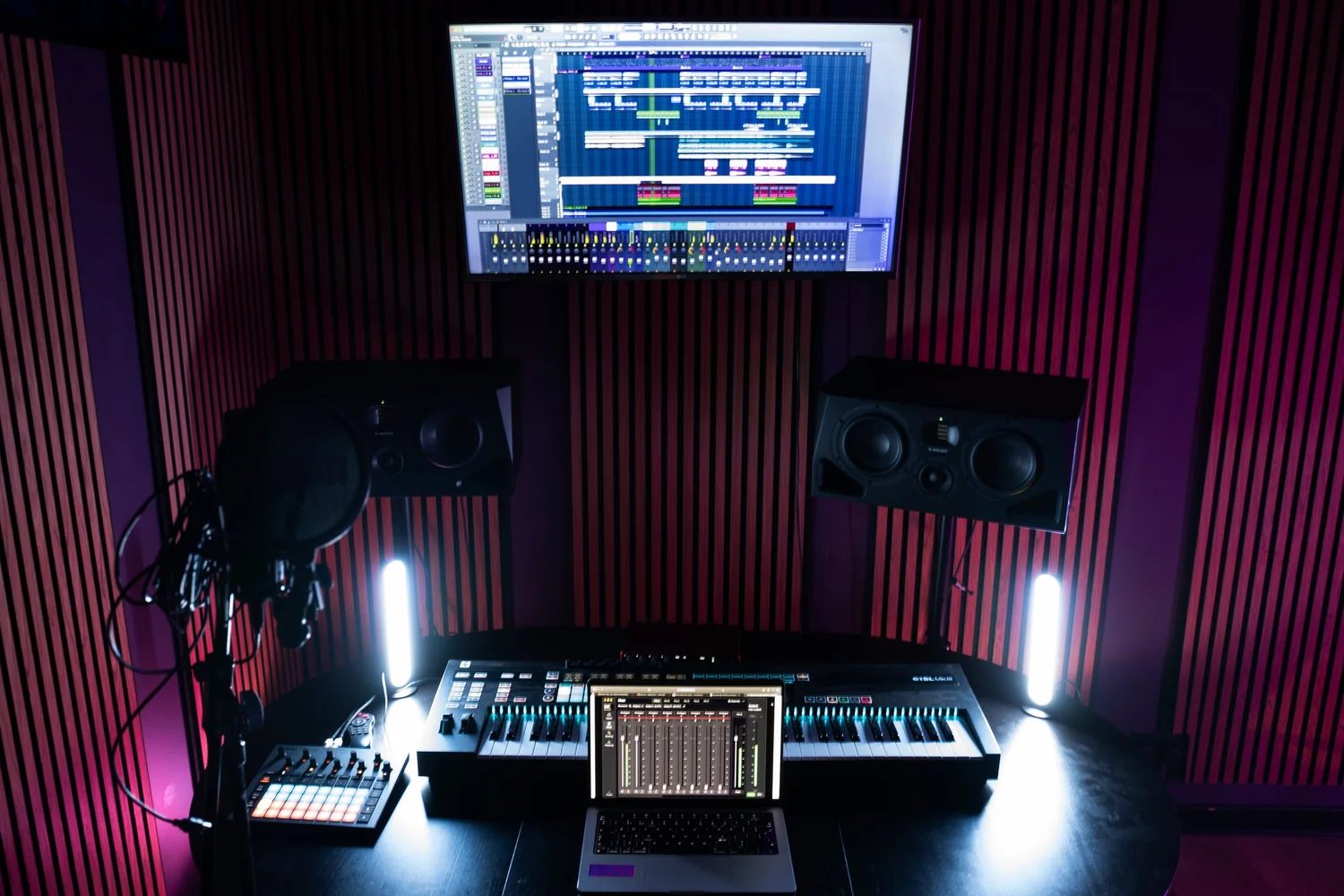
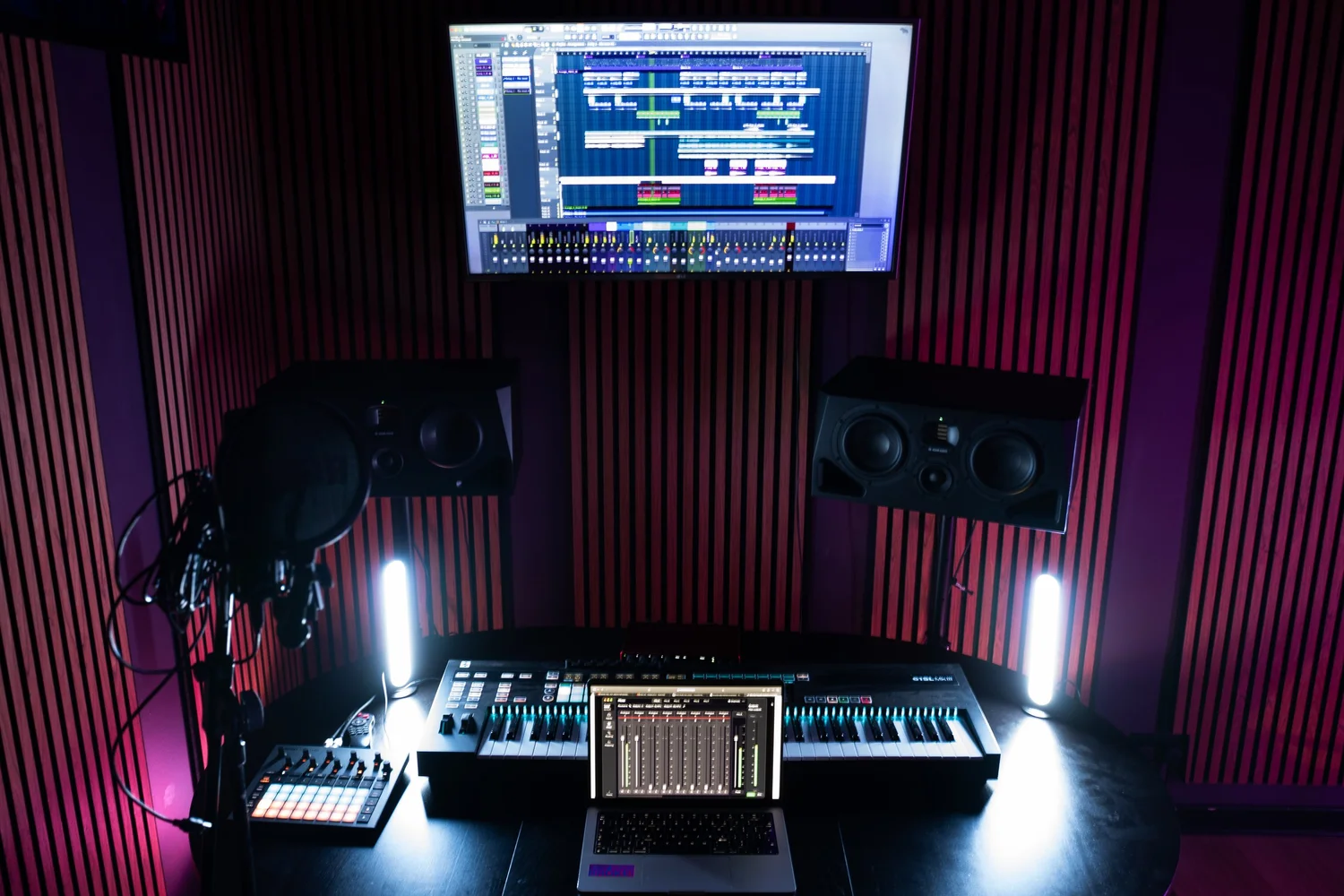
There is a Scarlett 18i16 wired into the desk in our Wapping music studio, feeding a pair of ADAM Audio A77H monitors, with a Novation 61SL MkIII and a Circuit Rhythm sitting next to it. You can book the room for £50 per hour excluding VAT, bring a laptop, and start recording. Nothing to hire, nothing to set up, no equipment fees.
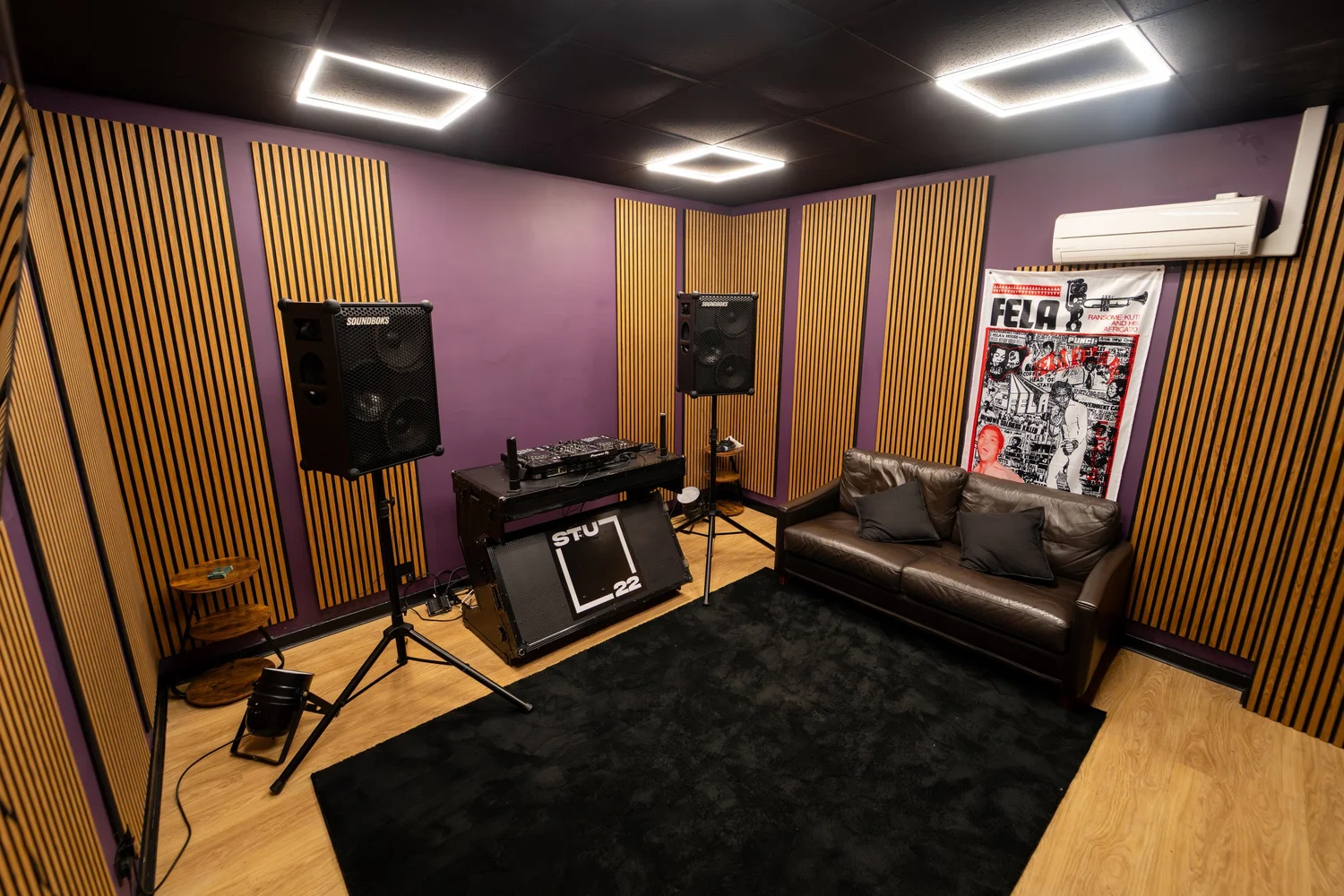
The Portal, STU 22, Sampson Street, Wapping E1W 1NA.
What it is
The Box Everything Else Plugs Into
An audio interface is the piece of equipment that turns sound into something a computer can record, and then turns it back into something you can hear properly. It is the least glamorous item in any studio and the one that decides most of how your recording sounds. A good microphone through a poor interface sounds worse than a modest microphone through a good one.
The Scarlett 18i16 is the upper end of Focusrite's Scarlett range, the fourth generation, released in late 2024. The short version of what it gives you: four microphone preamplifiers, eight analogue inputs, 24-bit recording at up to 192 kHz, and converters drawn from Focusrite's RedNet professional line. Focusrite publish a dynamic range of 116 dB on the microphone inputs and equivalent input noise of −127 dBu, which in plain terms means the preamps are quiet enough that a close vocal or a quiet acoustic guitar comes back clean rather than hissy.
Focusrite are a British company, and the Scarlett range is the most widely used audio interface family in the world. If you have watched someone record at home on YouTube, you have almost certainly seen a red Focusrite box in the corner of the frame. The 18i16 is the version of that box built for a room where more than one person is playing at once.
Why this room, specifically
It Is Not the Interface That Matters, It Is What It Is Plugged Into
Plenty of places will let you record through a Scarlett. What makes The Portal unusual is that the whole signal path is built from one family of equipment, designed by people working in the same company.
Focusrite Group owns eight brands. Three of them are in this room. The Scarlett 18i16 is Focusrite. The 61SL MkIII keyboard and the Circuit Rhythm groovebox are Novation, which Focusrite acquired in 2004. The A77H monitors you hear everything through are ADAM Audio, which Focusrite acquired in 2019.
So the sound goes in through a Focusrite preamp, gets played and sequenced on Novation instruments, and comes back out through ADAM monitors, with no mismatched link in the chain and nothing needing adapters or a workaround. That is a genuinely rare thing to find in a room you can book by the hour, and it is why we describe The Portal as a partnership rather than a shopping list.
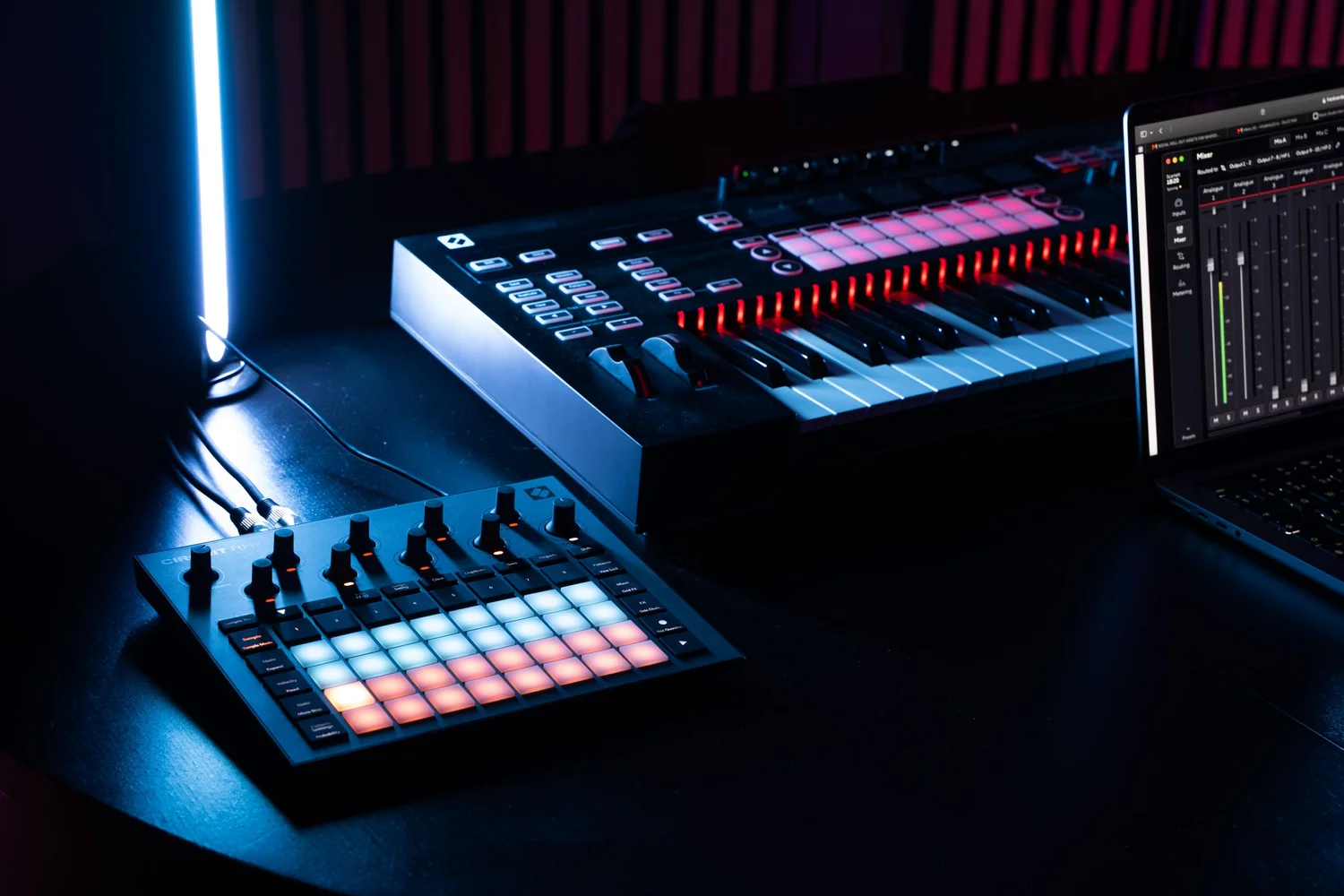
Three Focusrite Group brands in one signal path: Focusrite, Novation and ADAM Audio.
In practice
What Four Preamps Actually Lets You Do
Most home setups have one or two inputs, which means recording one thing at a time and building a track in layers. Four microphone preamps and eight analogue inputs changes the kind of session you can run.
Vocals, properly
One singer, one good microphone, a quiet treated room and a preamp with 69 dB of gain available. This is the most common booking and the one the room is best at.
Two people at once
A vocal and a guitar live together, or two vocalists trading lines, each on their own channel so you can fix one without touching the other.
Podcasts and interviews
Up to four microphones, each recorded separately. Loopback channels let you pull a remote guest from a video call straight into the session without extra software.
Hardware and synths
Four line inputs on the back for synths, drum machines and outboard, so you can run a hybrid setup instead of working entirely inside a laptop.
Channels one and two also switch to instrument level, so a guitar or bass can go in direct with no amp and no separate DI box.
Features worth knowing
Three Things That Change How a Session Runs
Auto Gain
Setting record levels is the part of a session that eats time and goes wrong. Too low and the recording is noisy, too high and it distorts. Auto Gain listens to you sing or play for about ten seconds and sets the level itself. If you have never set a gain level in your life, this removes the main thing standing between you and a usable take.
Clip Safe
Distortion from a signal that is too loud cannot be repaired afterwards. The take is simply gone. Clip Safe watches the input thousands of times a second and pulls the gain back if you are about to clip. It means the loudest moment of a performance, which is usually the best moment, survives.
Air
A button that changes the character of the preamp. The first press adds Air Presence, which lifts the top end and gives a vocal the open quality you associate with an expensive condenser microphone. A second press adds Harmonic Drive on top, which is new to this generation and adds the warmth and slight grit of older valve equipment. It is a genuine change in tone rather than a gimmick, and it is worth trying both ways on a vocal before you commit.
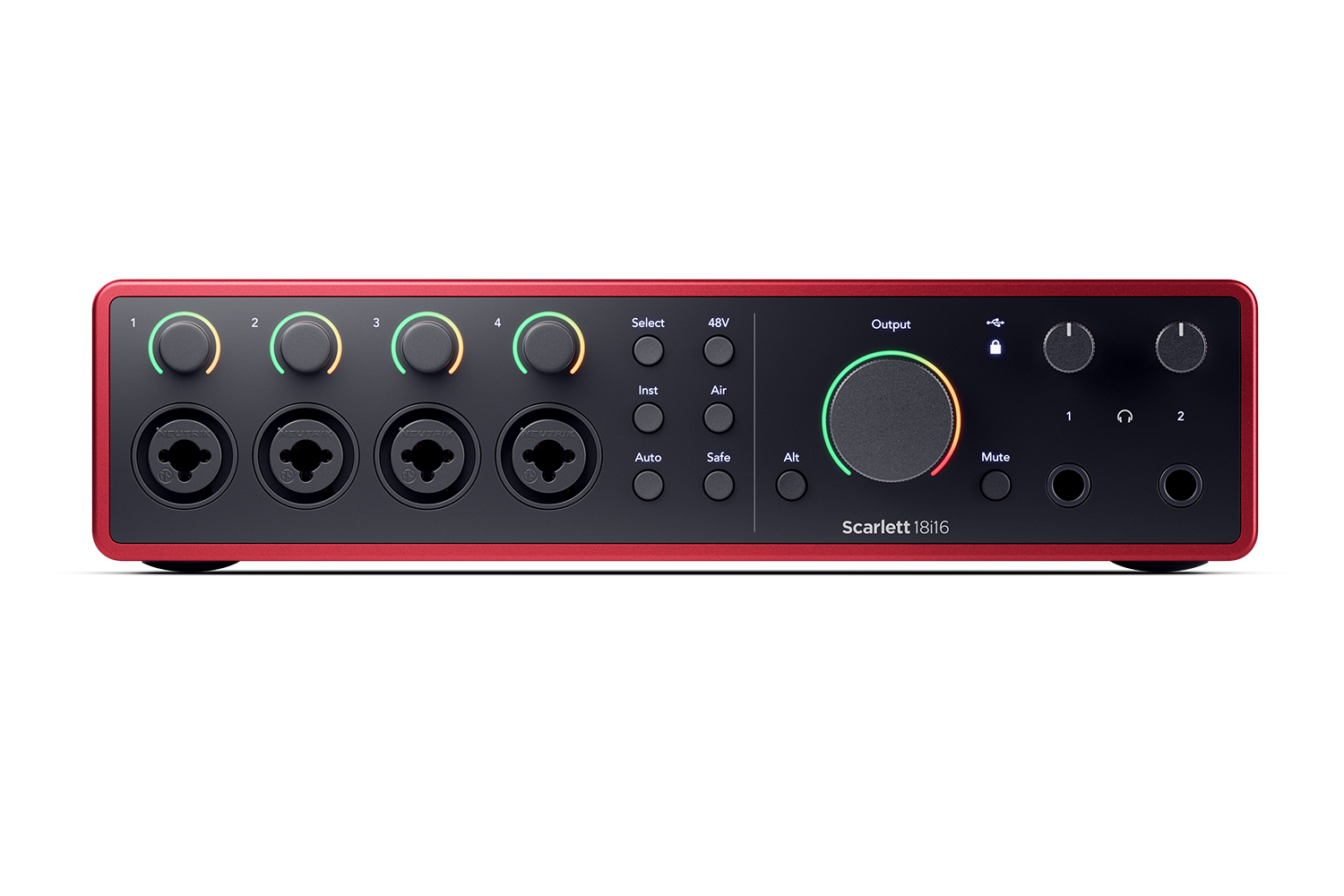
Focusrite manufacturer image of the 18i16 front panel. The unit in The Portal is this model.
Straight answers
What It Is Not Good For
We would rather you arrive knowing what the room can and cannot do than find out during a paid hour. So here are the real limits.
A full drum kit is a stretch. Four microphone preamps covers kick, snare and a pair of overheads, which is a legitimate way to record drums, but it is not close miking every drum and cymbal. If that is your plan, talk to us first.
There is one headphone socket. Fine for one or two people. If you are tracking three or four musicians who all need to hear a mix, ask us before you book so we can sort headphone feeds rather than you discovering the problem on the day.
Only two channels take an instrument directly. Two guitars in at once is fine. Three is not, without a DI box.
It is not the lowest-latency interface made. For most recording this is irrelevant. If you are monitoring through heavy plugin chains while you play, specialist interfaces from the likes of RME do that better, and we would rather say so than pretend otherwise.
It is a desktop unit, not a rack unit. The rackmount sibling is the 18i20. If you specifically need rack format for a reason, this is not that.
Reference
Full Specifications
| Model | Focusrite Scarlett 18i16, 4th Generation |
|---|---|
| Total channels | 18 in, 16 out |
| Analogue inputs | Four front-panel Neutrik Combo XLR / 6.35 mm TRS, plus four rear-panel 6.35 mm TRS line inputs |
| Microphone preamps | Four, with automatic mic/line switching |
| Instrument inputs | Channels 1 and 2, switchable to instrument level |
| Analogue outputs | Four balanced 6.35 mm jack outputs: two Main, two Alt |
| Headphone output | One front-panel stereo 6.35 mm TRS |
| Digital I/O | Coaxial S/PDIF, plus an optical port switchable between ADAT and S/PDIF |
| Loopback | Channels 9 and 10 |
| Bit depth | 24-bit |
| Sample rates | 44.1, 48, 88.2, 96, 176.4 and 192 kHz |
| Mic preamp gain range | 69 dB |
| Mic preamp dynamic range | 116 dB, A-weighted |
| Mic preamp noise (EIN) | −127 dBu, A-weighted |
| Mic preamp THD+N | −100 dB at 8 dB gain |
| Mic input frequency response | 20 Hz to 20 kHz, ± 0.06 dB |
| Line input frequency response | 20 Hz to 20 kHz, ± 0.05 dB |
| Maximum mic input level | 16 dBu at minimum gain |
| Mic input impedance | 3 kΩ |
| Phantom power | 48 V, front-panel button or software switch |
| Connection | USB Type-C, bus powered |
| Control software | Focusrite Control 2, including remote control from a phone |
Focusrite measure performance figures following AES17 where possible. We have quoted their published numbers rather than our own, because we have no way to measure them independently and would rather not pretend we do.
The maths
Hire an Hour, or Buy the Lot
A Scarlett 18i16 is roughly £400 new in the UK. That is the cheapest item in the chain. Add a Novation 61SL MkIII, a Circuit Rhythm, a pair of ADAM A77H monitors and a microphone and you are a long way past two thousand pounds before you have considered the room itself, which is the part that actually decides whether a recording sounds good.
An hour in The Portal is £50 excluding VAT, with everything in this page included, in a room that is acoustically treated and sound-isolated. There are no equipment fees, no cleaning charges and no minimum spend beyond the one-hour minimum. Bring a laptop and headphones if you have your own preference, and that is it.
It is also, frankly, the sensible way to find out whether you actually like this equipment before spending the money. Plenty of people book an hour, try the Air button on their own voice, and go home knowing exactly what to buy.
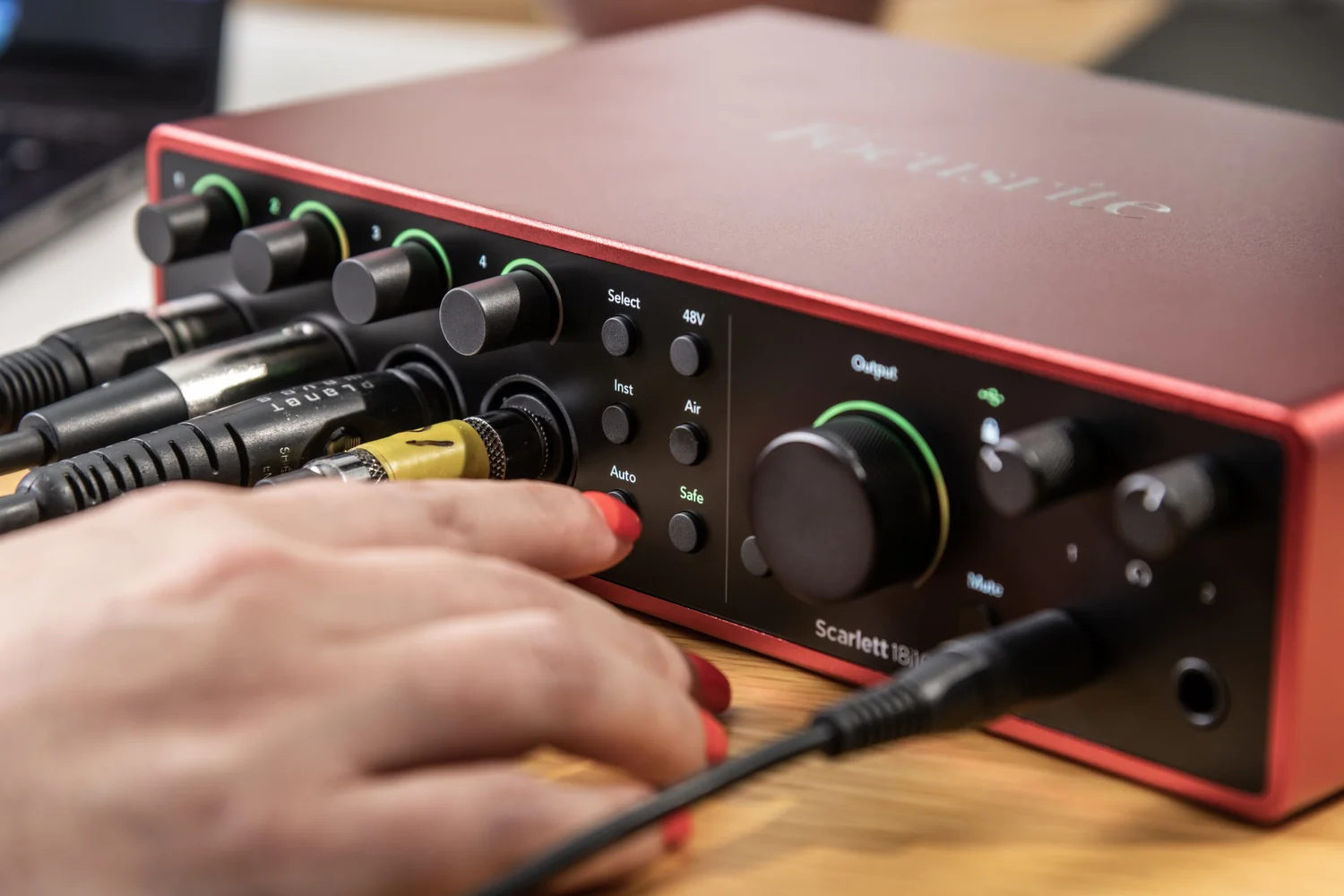
Focusrite manufacturer image. Supplied to us as an official Focusrite partner studio.
Questions
Before You Book
Do I need to bring a computer?
Yes. We do not supply a computer or recording software, so bring your own laptop with whatever you already use, Logic, Ableton, Pro Tools, FL Studio or anything else. The interface connects over USB-C and is class compliant, so Mac, Windows and iPad all work without special drivers. If your laptop only has USB-A ports, bring an adapter or tell us in advance.
How much does it cost to use the Scarlett 18i16 here?
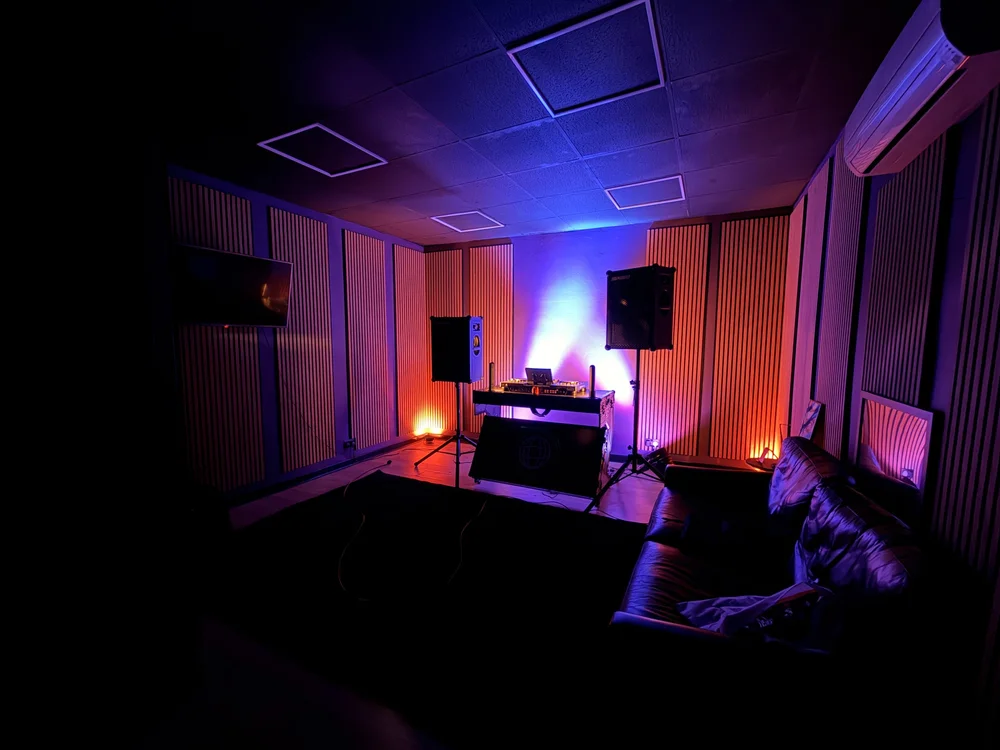
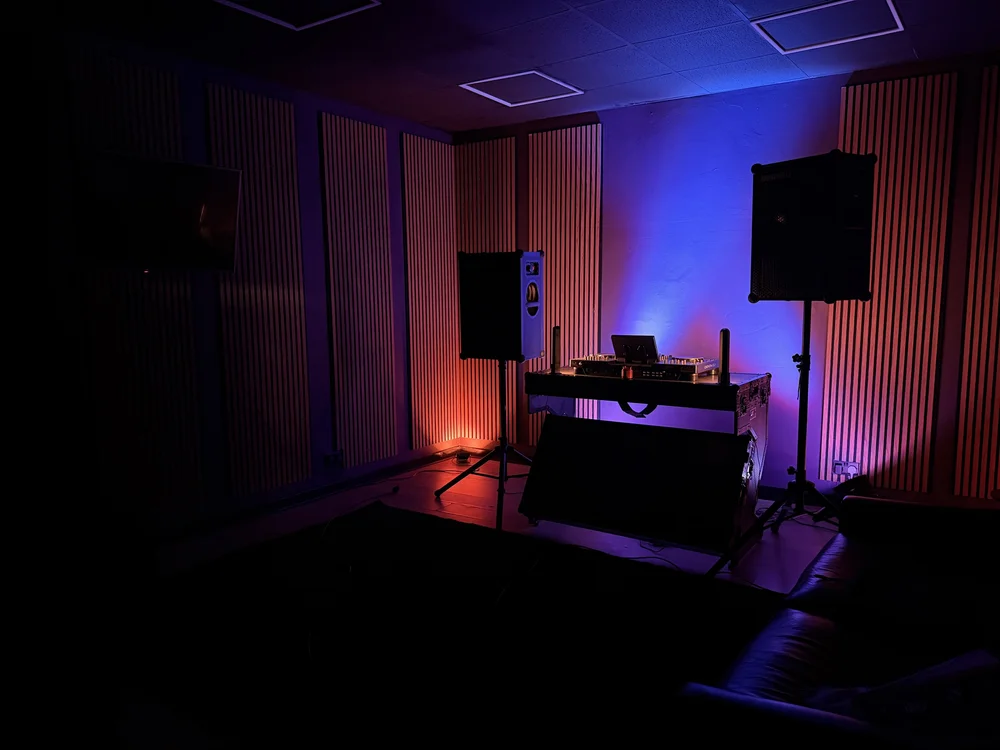
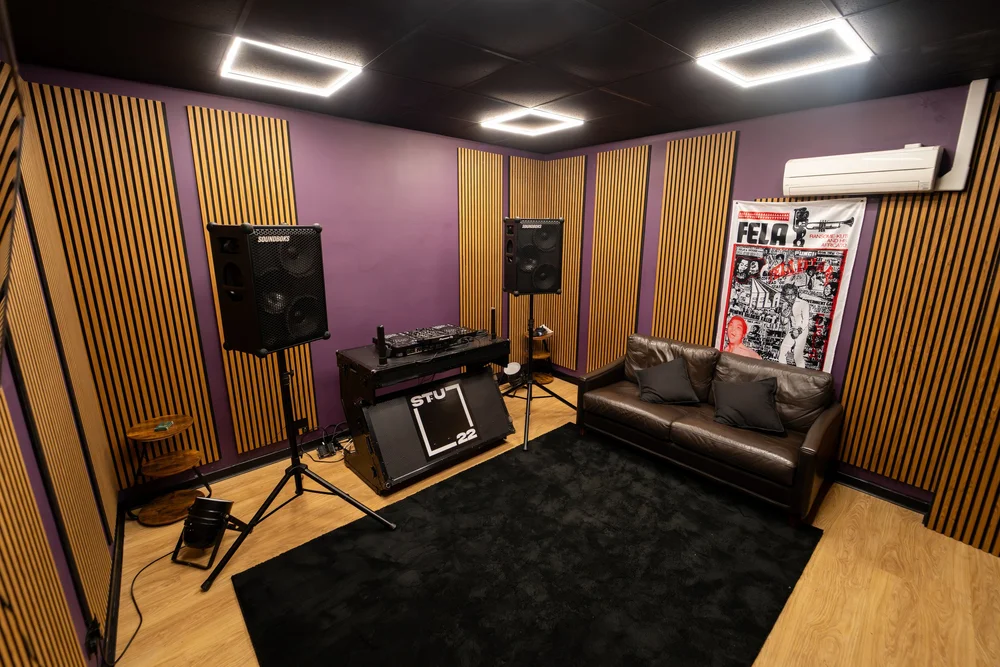
The music studio in The Portal is £50 per hour excluding VAT, with a one-hour minimum, and the Scarlett 18i16 is included in that along with the Novation 61SL MkIII, the Circuit Rhythm and the ADAM A77H monitors. The DJ room next door is £35 per hour and both rooms together are £70 per hour. Half-day and full-day rates are quoted on request.
Can I record a band live in the room?
A small setup, yes. Four microphone preamps plus four line inputs handles a vocal, a couple of instruments and a basic drum setup of kick, snare and overheads. A full close-miked drum kit with a live band is beyond what this room is built for. Message us on WhatsApp with what you are planning and we will tell you honestly whether it will work.
Is there an engineer, or do I run the session myself?
Sessions are self-operated by default, which is part of why the rate is what it is. We will get you set up and show you how the room works, and then it is yours. If you would rather have someone running it, ask when you book and we will tell you what we can arrange.
What is the Air button and should I use it?
Air changes the tone of the preamp. One press adds Air Presence, which brightens and opens up the top end of a vocal. A second press adds Harmonic Drive as well, which brings in the warmth and mild saturation of older valve gear. Record a few bars with it off, with Presence, and with both, then pick. It takes two minutes and it is the single easiest way to make a vocal sit better.
Where is the studio and how do I get there?
STU 22 is at 8-10 Sampson Street, Wapping, London E1W 1NA. It is about five minutes from Wapping Overground, ten from Shoreditch and ten from Canary Wharf, and a short walk from Tobacco Dock and St Katharine Docks. We are open 08:00 to 22:00 seven days a week, and we hold a 24-hour premises licence, so late-night and overnight sessions can be arranged at special rates.
Can I come and try it before buying one?
Yes, and people do. Book an hour in the music studio, bring your own microphone or use ours, and spend the time working out whether the preamps and the Air setting do what you want on your own material. It is a considerably cheaper way to decide than buying and returning.
Book the music studio from £50 per hour. Everything on this page is included. Same-day bookings are usually possible, so message us if you want the room today.
Book online WhatsApp us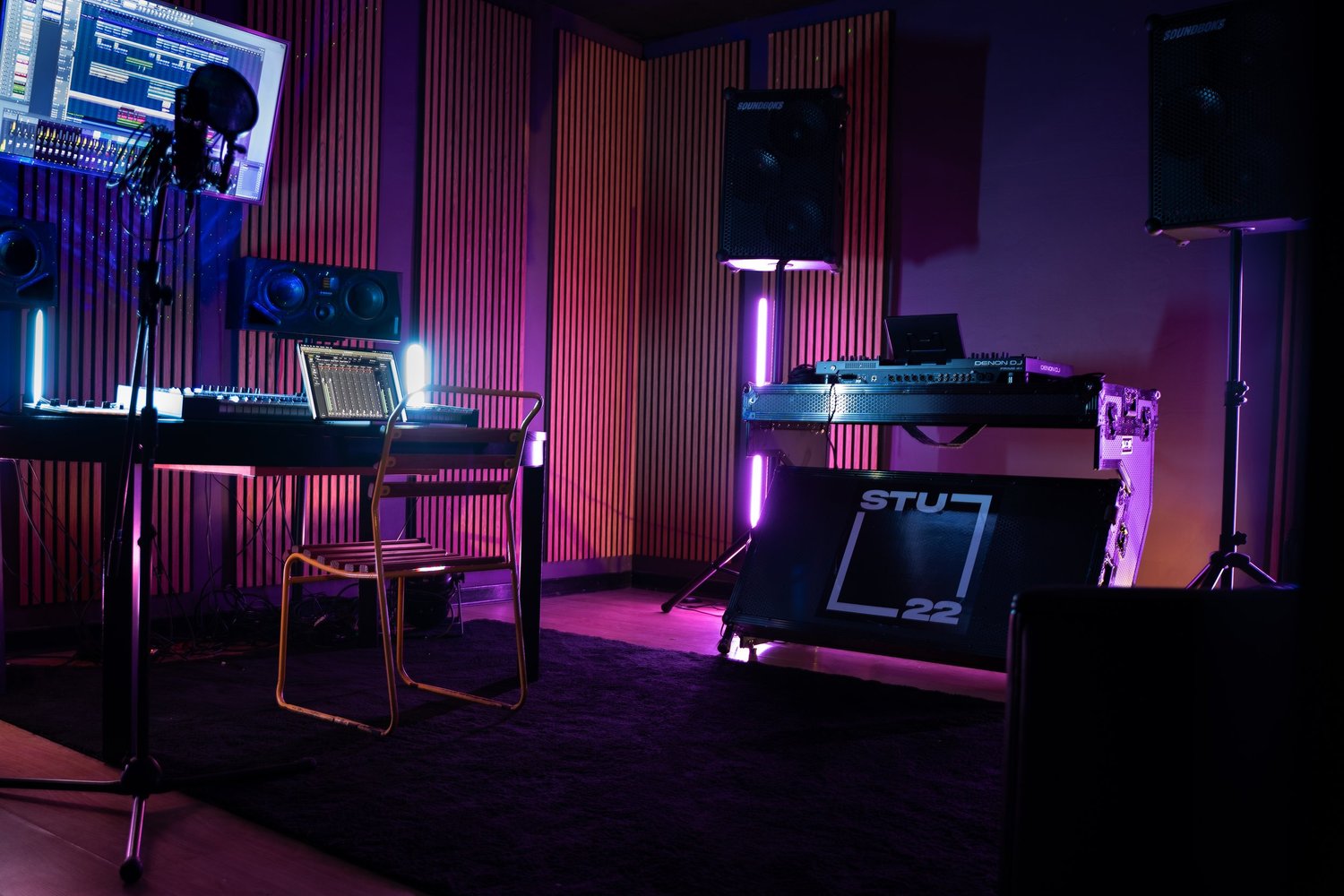
The Portal, STU 22, 8-10 Sampson Street, Wapping E1W 1NA.
More on the room itself on The Portal, the full equipment list across all three studios on our equipment page, and the background to the partnership in London's Focusrite partner studio. If you want the space rather than the gear, all three studios are here.