How to Choose a Music Studio in London
How to choose a music studio in London is not about finding the lowest hourly rate. The cheapest room is often the most expensive in the long run, once you account for hidden costs, failed sessions, and time wasted on poor acoustics or missing equipment. This guide gives you a decision framework to compare studios fairly, spot red flags, and make a booking you won't regret. Whether you're looking at music studio hire in London or comparing recording studio rates, you'll learn what questions to ask.
Whether you're recording your first track or shopping around for a better room, you need to know what you're actually buying, how to read a rate card, what to listen for in a room, and which questions to ask before you pay a deposit. We'll work through each step with real examples from a music studio East London so you can see how it works in practice.
What You Are Actually Buying
A studio hire is not one thing. You need to separate what you're paying for, because many London studios list a room-only rate and add everything else on top. Understanding this difference saves money and stops you booking a space that does not have what you need.
You are buying some combination of the following:
- The room itself. Four walls, a treated ceiling, acoustic panels, and isolation from outside noise. This is the foundation. A good room costs money because acoustic treatment and soundproofing are expensive.
- Equipment. The studio's gear: monitors, microphone, interface, preamp, compressor, MIDI keyboards, decks. Every piece adds value. Some studios have high-end outboard kit; some have basics. Ask for a full gear list before you book.
- An engineer or producer. This is often priced separately. You might book a room at £50 per hour, then pay an engineer an additional £30 to £80 per hour. Not all studios have in-house engineers. Some studios do not offer this service at all, so you need to bring your own or work alone.
- Time and labour. Load-in, setup, file management, breakdown. Some studios build this into their hourly rate. Others charge extra for overtime or complex setups.
At STU 22's Portal, the hourly rate covers the room and equipment. There is no in-house engineer offered, but you are welcome to bring your own or work independently. That is clear from the rate card rather than buried in the small print, which is exactly what you want from a booking page so you know exactly what the £50 per hour (Music Studio) includes. That clarity matters.
Ready to evaluate a real studio?
Get a clear breakdown of what you're buying. Book a trial session at the Portal to see the room, test the gear, and experience the space before you commit.
Book a Trial SessionHourly, Half-Day, Full-Day and Block Bookings: The Maths
Different studios offer different booking models. Understanding when each wins saves you money and stops you overpaying for time you do not use.
Hourly Rates
You book by the hour. This suits short sessions, testing new equipment, recording a single song, or trying out a studio for the first time. If a studio has a 1 hour minimum, you must book in 1 hour blocks.
At STU 22, the Portal costs £50 per hour (Music Studio) plus VAT at 20 percent, which is £60 per hour. With a 1 hour minimum, a quick vocal session or beat session costs exactly £60. That minimum is actually useful because you are not penalised for short work and you can test the room affordably. This is a fair hourly recording studio rate for a professionally treated space in East London.
The math: 3 hours at £50 equals £150 plus VAT, £180 total. Perfect for a targeted session. But if you are there 5 hours, you are paying the same hourly rate throughout, which can feel expensive for a full day.
Half-Day and Full-Day Packages
Larger studios often offer half-day (usually 4 hours) and full-day (8 to 10 hours) packages at a discounted rate. You pay less per hour than the hourly rate, but you must commit to the full block. This suits longer sessions: tracking a full EP, mixing, or working with a band.
Example: if an hourly rate is £50, a half-day might be £160 (4 hours at £40 per hour). You save £40 over the hourly rate. But you must use all 4 hours or lose the discount.
STU 22 does not advertise half-day or full-day discounts on the Portal website. They work on an hourly basis with a 1 hour minimum. If you know you need 4 or 8 hours, ask them directly via WhatsApp: studios often negotiate block rates for serious bookings, even if they are not advertised.
The 1 Hour Minimum: Planning Around It
A 1 hour minimum sounds simple, but it changes how you plan sessions. You cannot book 45 minutes. If you arrive at 10am and leave at 10:40am, you still pay for 1 hour.
Plan your session to use the full hour: arrange your files before you arrive, get your levels set quickly, and treat the minimum as a feature, not a bug. A 1 hour minimum keeps rates affordable because the studio is not managing constant tiny bookings.
Worked Example: Cost Comparison
You want to record 4 vocals. At STU 22 Portal rates (£50 per hour, 20 percent VAT):
- Book 1 hour for all 4 vocals: £50 + VAT = £60. This works if you are efficient and know the arrangement.
- Book 2 hours: £100 + VAT = £120. Safer margin for multiple takes and fixing issues.
- Book 4 hours (a half-day equivalent): £200 + VAT = £240. Adds buffer for experimentation and breakdown.
The hourly model means you only pay for what you use. You avoid the half-day penalty if you finish in 2.5 hours.
| Booking Model | Best For | Watch Out For | Typical Use Case |
|---|---|---|---|
| Hourly | Flexibility, testing, short sessions | Rate adds up fast for full days | Single vocal, beat session, first-time booking |
| Half-Day | Modest discount, 4 hour session | You lose the discount if you finish early | 3 to 4 hour session, not full day |
| Full-Day | Best per-hour rate, tracking full EP | Commits you to 8-10 hours, can tire you out | Tracking 5 to 10 songs, mixing session |
| Block Booking | Lowest rate, immersive project work | Requires large upfront payment, hard to cancel | Album project, 3 to 10 days of work |
VAT, Hidden Costs and Questions That Surface Them
VAT at 20 percent is the first hidden cost. Most UK studios quote rates excluding VAT, which means the price you see is not the price you pay. Always ask for an inclusive or exclusive quote so you know what to budget.
Beyond VAT, watch for these costs that quietly ruin budgets:
- Engineer fees. Separate from room hire. Can be £30 to £100 per hour depending on experience. Not all studios offer this; some expect you to bring your own.
- Setup and breakdown time. Some studios charge for setup if the session is complex (band tracking, many overdubs). Others include it.
- File transfer and delivery. High-resolution stems, backup drives, or cloud storage sometimes cost extra. Ask whether files are included in the rate or charged separately.
- Travel and parking. Location matters. Transport links from your area add cost and time. Parking can be £2 to £5 per hour or unclear.
- Overtime. Running over time costs per-hour surcharges, often at a higher rate than booked time.
- Deposit or cancellation fees. Some studios require 50 percent upfront; others hold you to 48 hour cancellation policies.
STU 22's Portal at £50 per hour is straightforward: room and gear, 1 hour minimum, no mention of hidden extras. The VAT is clear. No in-house engineer is mentioned, which tells you that if you want one, you source them separately. That transparency is rare and valuable.
The Cost Questions to Ask
Ask these before you book:
- Is the quoted rate inclusive or exclusive of VAT?
- What is included in the room hire? (gear, engineer, setup, teardown)
- Is there a setup fee if I am bringing my own gear?
- How much is overtime per hour if I run over?
- Are file transfers included? What format and delivery method?
- What is the cancellation policy and deposit percentage?
- Is parking available and is it free or paid?
Room Types: Live Rooms, Booths, Treated Rooms and Why They Matter
If you want to see what a fully panelled single room actually looks like in practice, our tour of a Focusrite partner studio in London walks through the Portal piece by piece, and our overview of music studio hire in East London sets out how the area compares on price.
Not all studio spaces are the same. Understanding the difference between a live room, a vocal booth, and a fully treated single room shapes everything about your session.
Live Rooms
A live room is spacious, reverberant, and designed for drums or full band tracking. Natural reflections from the walls and ceiling create space and energy. Excellent for capturing the character of live instruments playing together. Poor for vocal recording because the room is too bright and reverb-heavy.
Vocal Booths
A small, heavily treated box designed for close vocals. Isolation is tight. Reverb is minimal because the walls absorb sound. Perfect for clean, controlled vocals. Claustrophobic for some people. Overkill if you are recording beats or samples.
Fully Treated Single Rooms
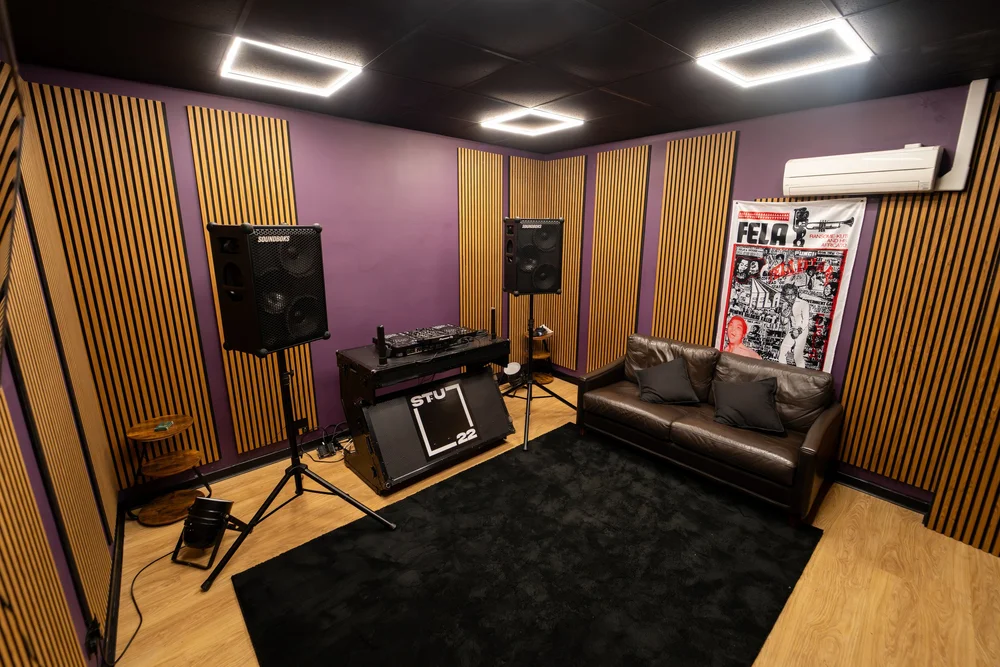
The sweet spot for independent artists and rappers. A medium-sized room with acoustic panelling on all walls and ceiling, isolated from the building. Dry (minimal reverb), versatile, and dead enough for focused recording but not claustrophobic. You can record vocals, guitars, drums, podcast, or work over beats.
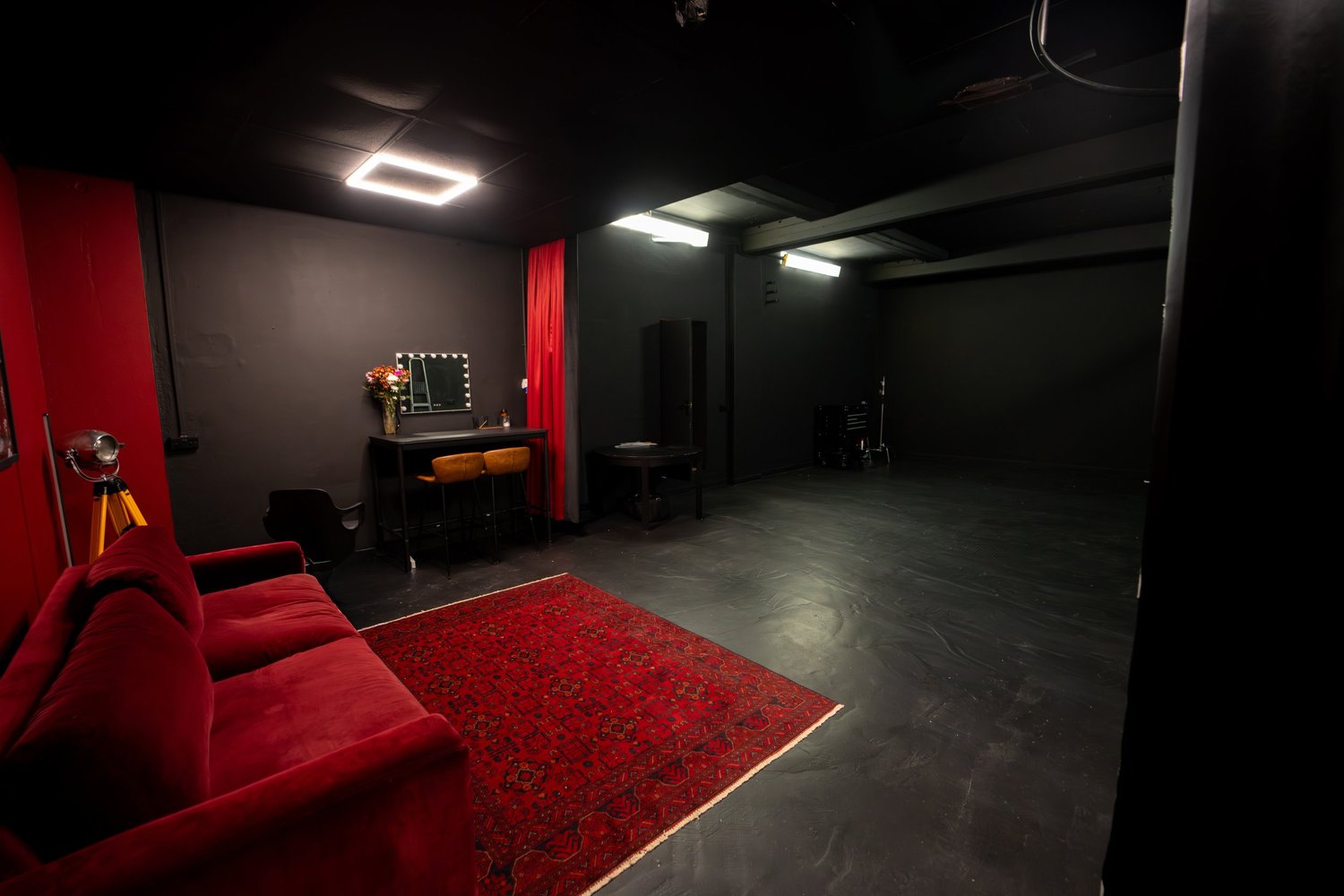
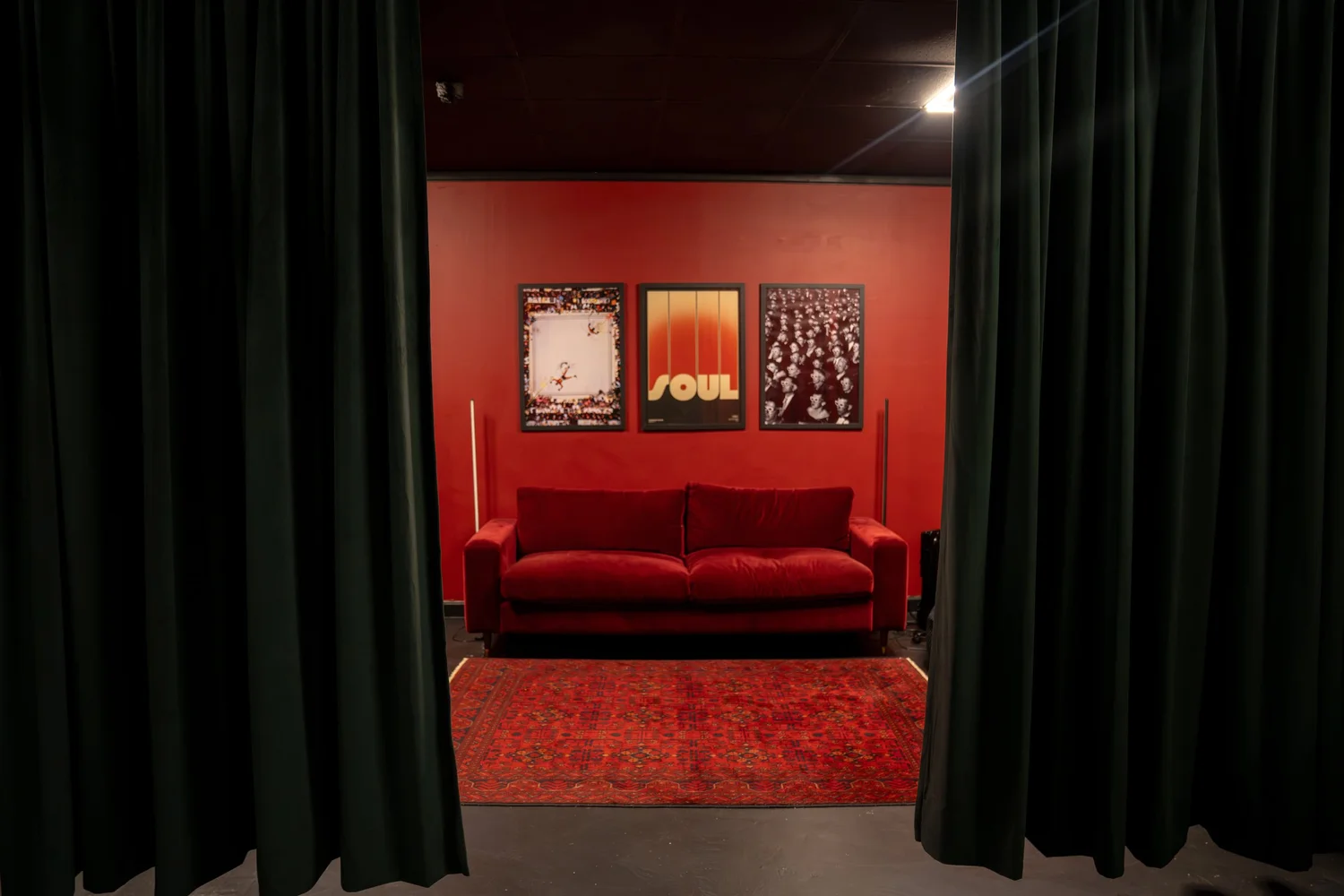
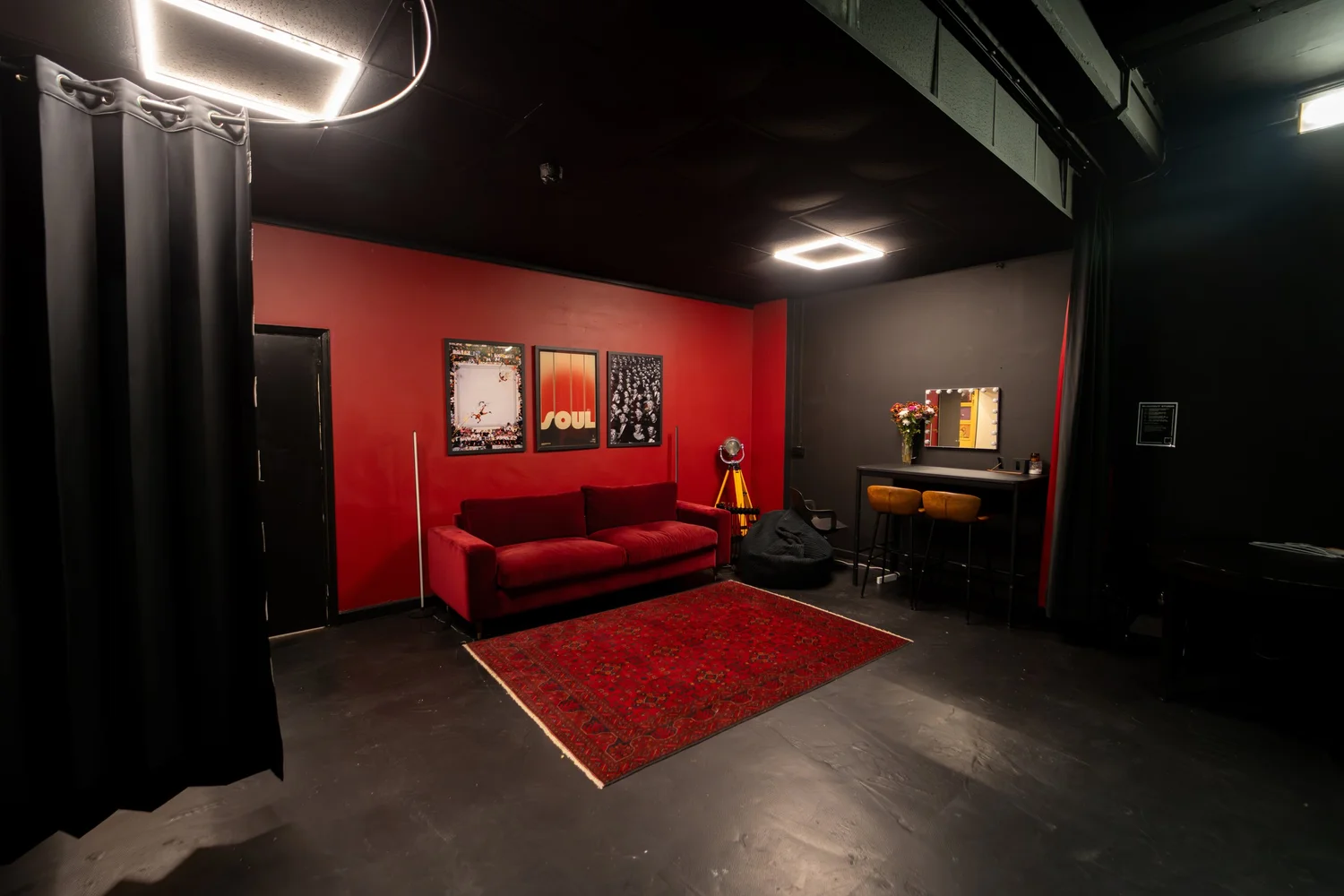
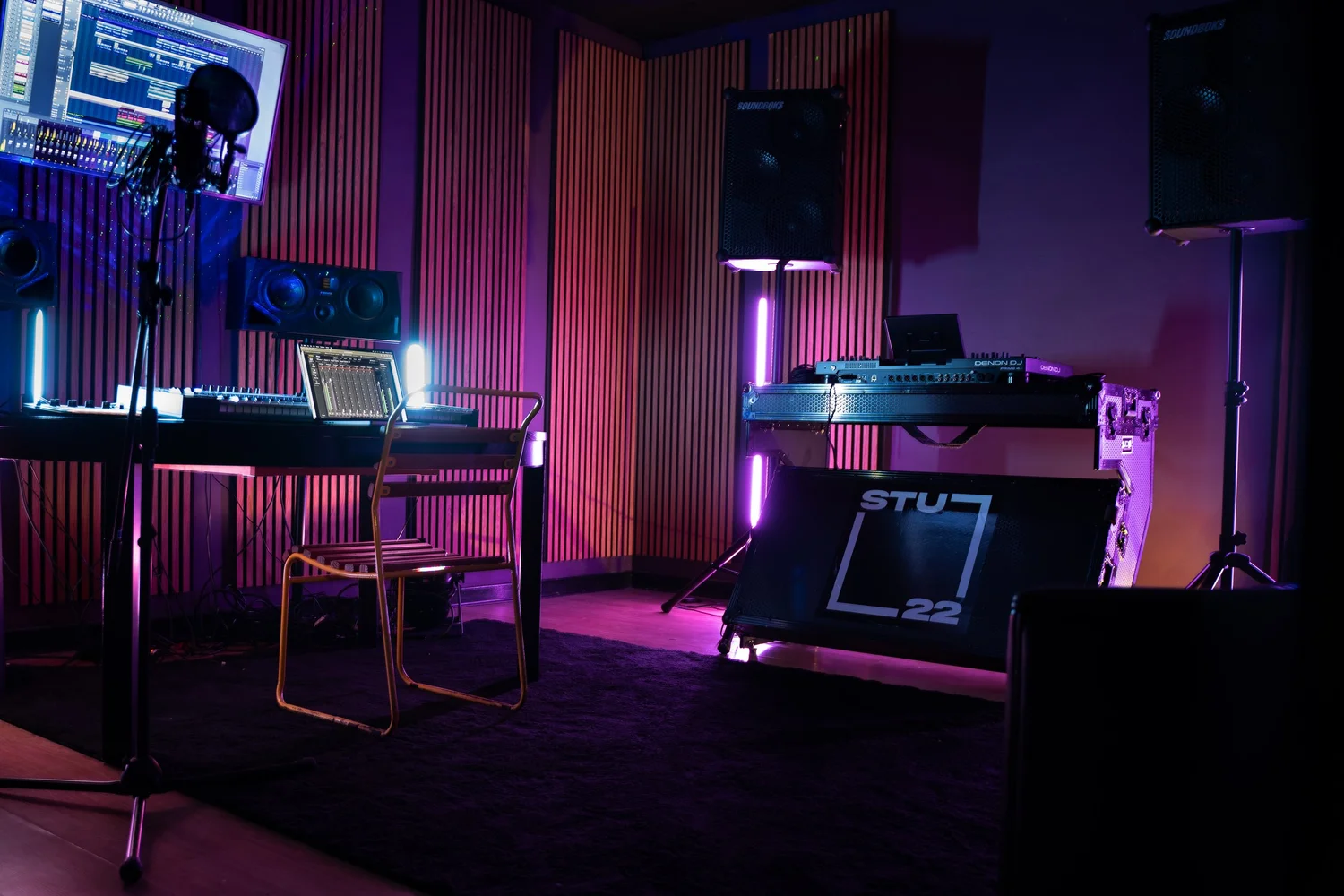
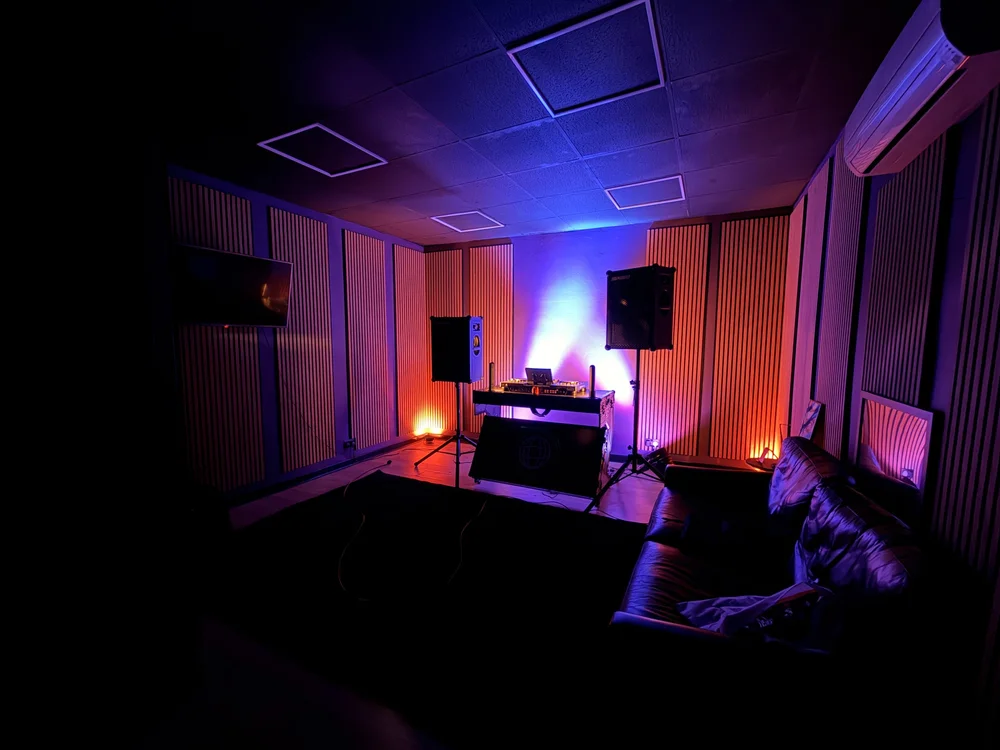
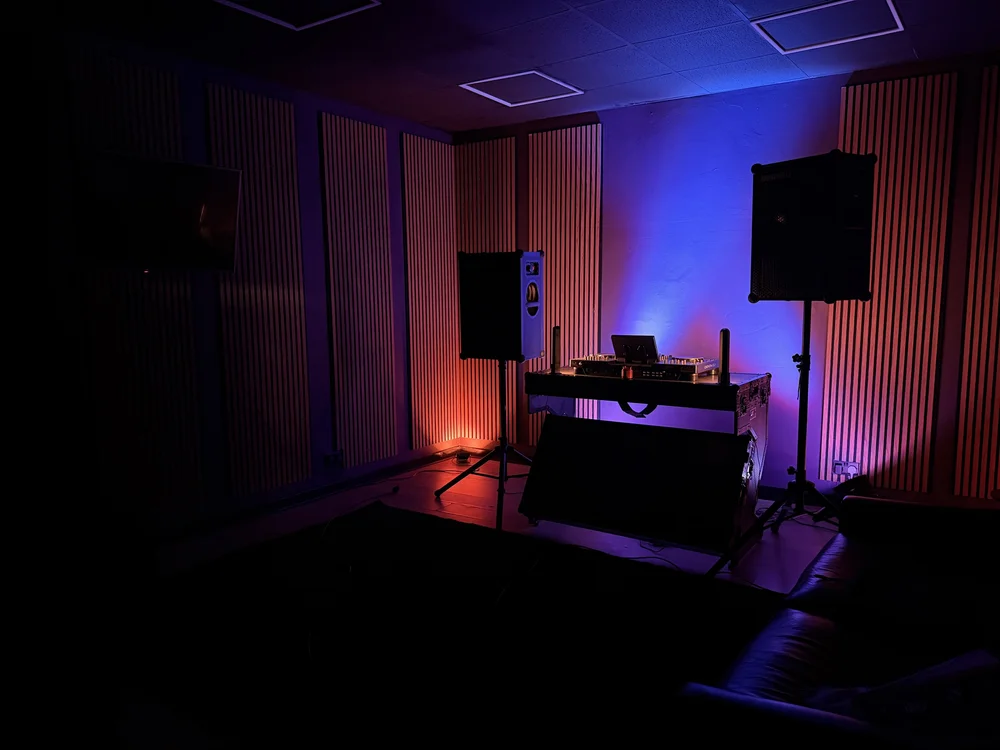
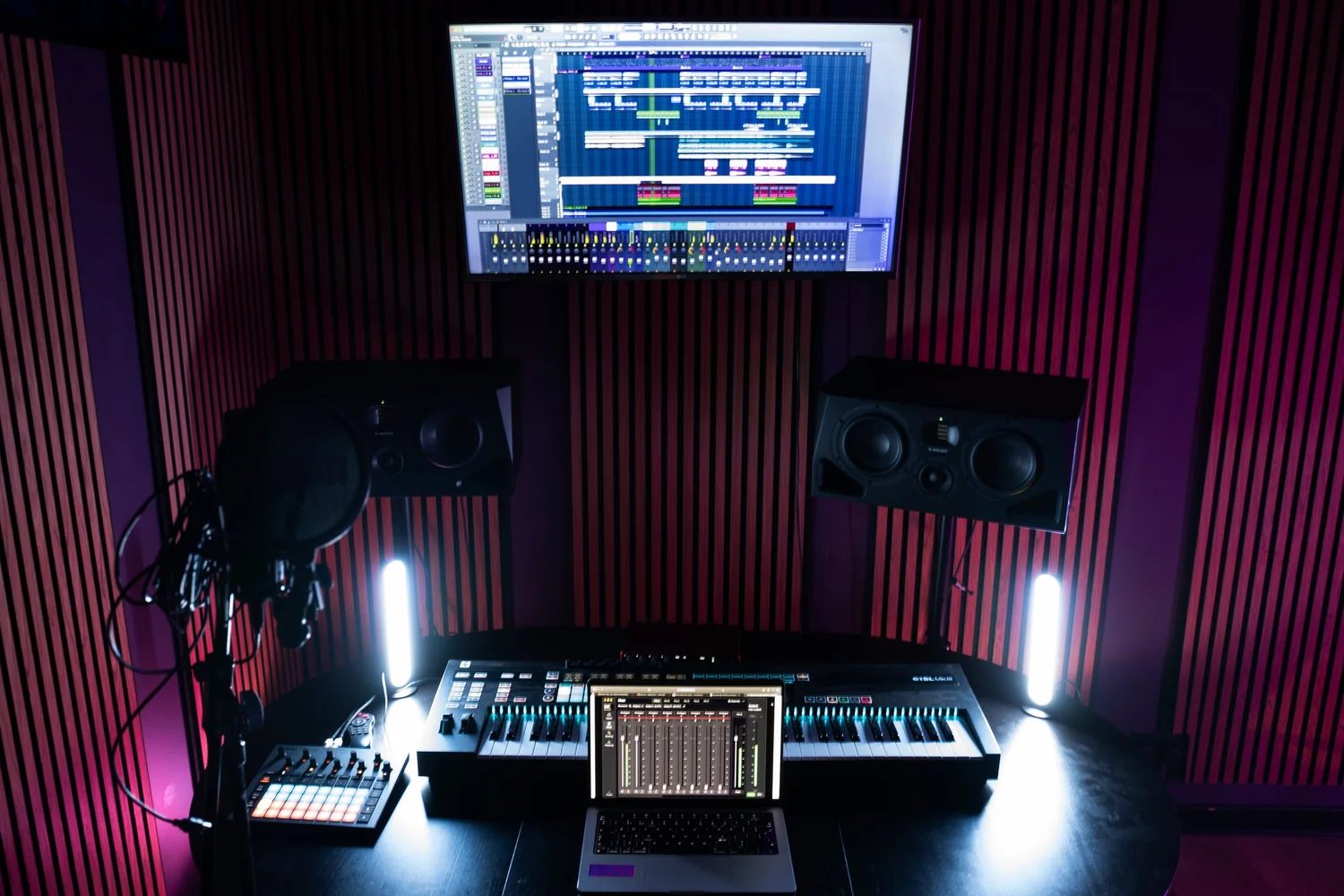
STU 22's Portal is exactly this type of room. Full acoustic panelling on walls and ceiling, isolated from the rest of the building, large enough to set up multiple pieces of gear without feeling cramped. For a solo artist recording vocals over a beat, or a rapper tracking multiple takes, this room type is the perfect fit. Not overkill, not underprepared.
How to Evaluate Acoustics Without Being an Engineer
What to look for in a recording studio starts with the room itself. You do not need a sound meter to judge a room. Your ears can spot fundamental problems in minutes.
The Clap Test
Stand in the middle of the room and clap once. Listen to what happens. A good treated room should absorb the clap quickly, leaving a dry sound. A bad room echoes, buzzes, or rings. If the clap resonates, the room is not treating reflections well. Some echo is normal; ring or flutter is a red flag.
Flutter Echo
Flutter echo is a rapid, machine-like repeating sound when you clap or speak. It means sound is bouncing between parallel walls without being absorbed. This is terrible for recording. If you hear it, move on.
Check the Ceiling
Many studios treat the walls well but leave the ceiling bare. Reflections from above are often forgotten. A bare ceiling creates harsh high-frequency reflections that colour your vocal and make mixing harder. Ask whether the ceiling is treated. Look up and see.
Test at Multiple Spots
Rooms sound different in different places. Clap near the corner, near a wall, in the middle, and by the window (if there is one). Corners often sound boomy; walls sound different from the centre. You need to record in a spot, so test the spot you will use.
Listen for External Noise
Traffic, plumbing, neighbours, footsteps in the building above. These are isolation problems. Visit at the time of day you plan to book. Is there building isolation? Ask directly: "Is this room soundproofed from the rest of the building?" A room isolated from its building is worth more money because you are not fighting traffic noise or footsteps.
STU 22's Portal is fully isolated from the rest of the building, which is why it handles street noise in Wapping without bleeding through. That detail matters when you are in East London near major transport.
Monitoring: Why Accuracy Beats Volume
Studio monitors are not speakers for loud music. They are precision tools that tell you exactly what is recorded, without colour or flattery. A pair of accurate monitors at moderate volume beats a pair of loud, coloured speakers.
Why this matters: if the monitors in a studio lie, your vocal sounds great in the room but bad everywhere else. You spend the money and get bad results.
Ask what monitors the studio uses. Research them if you do not know the brand. ADAM Audio is professional-grade. KRK or Yamaha are solid mid-range. Unknown budget brands are a red flag. The Portal uses ADAM Audio A77H monitors, which are industry-standard nearfield monitors trusted by professional engineers.
But here is the practical hack: bring headphones you already know. Sennheiser HD650, Beyerdynamic DT770, Apple AirPods Pro, even your favourite earbuds. Record a few takes on your headphones alongside the studio monitors. If your headphones agree with the monitors, you are in a good room. If they disagree, the monitors are colouring your sound.
Signal Chain Basics: Interface, Inputs and Microphones
The signal chain is the path sound takes from your microphone to the computer. Understand it and you know what you are paying for.
Microphone (input) → interface (converts analogue to digital) → DAW (recording software) → monitors (output). That is the chain.
The Interface
The interface is the hardware that captures sound. Good ones have low noise, plenty of inputs, stable drivers. Ask what interface a studio uses. The Portal uses a Focusrite Scarlett 18i16, which is a professional-grade interface with 16 inputs and 16 outputs. That means you can plug in many microphones, keyboards, or instruments at once.
Budget interfaces have fewer inputs and noisier preamps (the circuits that boost microphone signal). If a studio uses a cheap interface, you lose clarity.
Inputs and Flexibility
Ask: can I plug in my own microphone? Can I connect my hardware synth or drum machine? Honest studios say yes and show you the inputs. Studios that say "no, you must use ours" are limiting you or hiding poor gear.
STU 22 stocks a RODE NT-USB microphone, which is a solid USB condenser for vocals, speech, and instruments. But you are welcome to bring your own microphone and plug it into the Focusrite interface. That flexibility is the mark of a professional space.
Microphones and Technique
A great vocal does not come from a rare microphone. It comes from mic technique: distance from the diaphragm (usually 15 to 25 centimetres), consistent angle, reducing plosives (the "p" and "b" sounds that punch into the mic). A good engineer or experienced artist knows these. A £300 microphone in the hands of someone who does not know technique produces worse results than a £100 microphone used correctly.
Logistics That Quietly Ruin Sessions
Location matters more than most artists expect, which is why we wrote about why Wapping has become a base for creative studios. If your session is a DJ set or a live mix rather than vocals, the guide to DJ studios for hire in London and the DJ room and music studio pairing are the better starting points.
Great acoustics mean nothing if you cannot get your gear into the room, park your car, or catch a train home at midnight.
Load In and Stairs
Ground floor, no stairs, no lift required. This saves your back, saves time, and means you can bring more gear. Many London studios are in converted warehouses or offices up three flights of stairs. You learn this the hard way when you are lugging a 50 kilogram amplifier.
STU 22's Portal is ground floor at 8-10 Sampson Street, Wapping. No stairs, no lift waiting. That is a practical advantage worth money.
Transport Links
How long does it take you to get there and back? If you are in Hackney or Whitechapel, you do not want a studio in Canary Wharf. The Portal is 5 minutes walk from Wapping Overground and 7 minutes from Shadwell DLR, which connects directly to Shoreditch, Hackney, and Central London.
Parking
Street parking available? Reserved spaces? Pay per hour? The Portal has street parking available in Wapping. You are not guaranteed a space immediately outside, but the area is not a parking nightmare like Soho or Clerkenwell.
Late Sessions and Licensing
Some studios close at 6pm or 9pm. If you want to record vocals at 11pm after day work, you need a studio with late licensing. The building matters: does it have a premises licence? Is recording allowed at 2am?
STU 22's building holds a 24 hour premises licence, which means late sessions are possible. That flexibility matters if you work full time and only record at night.
Power Sockets
Seems small, until you arrive with a laptop, synthesizer, external drive, microphone, and three cables need charging. Good studios have multiple 13A sockets spread around the room. The Portal has multiple sockets, so you are not fighting for power.
Small Crew
Can you bring your producer, engineer, or friend who assists? Some studios enforce "artist only" rules. Others welcome crew. Bigger rooms feel less cramped if you have 3 people in them.
Check these logistics for yourself.
A trial session lets you test parking, transport, load in, power sockets, and whether the room feels right with your crew. Message STU 22 to discuss what works for your session type.
WhatsApp STU 2215 Questions to Ask Before You Book
These studio booking questions surface everything you need to know about a studio. Ask them in an email, WhatsApp, or phone call. An honest studio answers clearly. Vague answers are a red flag.
About the space: Is the room fully acoustically treated on all walls and ceiling? Is it isolated from the rest of the building? What is the room size in metres? What is the ambience like if I clap once?
About equipment: What is the interface model and how many simultaneous inputs do you have? What microphone(s) do you provide? Can I bring my own microphone and plug it in? What are the studio monitors and how are they calibrated? Do you have MIDI keyboards, synthesisers, or outboard gear?
About engineers: Do you have an in-house engineer? If yes, what is their hourly rate? If no, can I bring my own?
About access and logistics: What is the address and what are the nearest transport links? How long from Wapping? From Shoreditch? Is load in on the ground floor or are there stairs? What is the parking situation? Can I bring 2 or 3 people with me?
About hours and booking: What are your opening hours? Do you allow late sessions? What is the premises licence status? Do you have a minimum booking length? Is there an overtime charge if I run over?
About the quote: Is the hourly rate inclusive or exclusive of VAT? What is included in the rate? Are setup, teardown, file transfer, or engineer fees separate? What is your cancellation policy?
At STU 22, these answers are straightforward: treated room, isolated, good size, dry acoustic, Focusrite Scarlett 18i16, RODE NT-USB included plus your own mic welcome, no in-house engineer mentioned (bring your own), ground floor in Wapping 5-7 mins from transport, parking available, 24 hour licence, 1 hour minimum, £50 per hour plus VAT, all clear on the website.
Red Flags: When Not to Book
Some red flags are dealbreakers. Do not ignore them.
- No clear rate card. "Prices available on inquiry" or "depends on the session". This is a sign of unprofessional booking or hidden markups. Professional studios publish their rates.
- Vague answers about what is included. "The rate covers the room and stuff" is not good enough. You need to know what "stuff" means. Are monitors included? Microphone? Interface inputs?
- No photos of the actual room. Website shows a pretty rendering but no real photos. This suggests the room does not look good in reality.
- No reviews or only fake ones. Genuine reviews show real problems and experiences. If a studio has zero reviews or only five-star reviews with no detail, that is suspicious.
- Pressure to pay a large deposit. 20 to 25 percent upfront is standard. 50 percent or "non-refundable" is aggressive.
- The room sounds bad. If the clap test sounds echoey, muffled, or ring, do not book. No amount of discount fixes a bad room.
- The engineer is dismissive of your questions. You are paying. You deserve clear answers. If they are annoyed or defensive, walk away.
STU 22 publishes rates, gear lists, photos of the actual Portal, and holds a 5.0 star rating from 67 plus reviews. That transparency is the opposite of these red flags.
Running a Trial Session Before You Commit
Once the room is chosen, the next decisions are about craft rather than logistics. Our pieces on vocal recording and production techniques and on shooting a music video in East London cover what happens after you have locked the booking, and all three rooms at STU 22 can be booked together if you want stills, video and audio in one day.
Book a cheap first session. Do not commit to a full day with a studio you have never used. A trial costs one hour and teaches you everything.
What to do in the trial:
- Arrive 10 minutes early. Check parking, load in, power sockets, and transport.
- Clap in several spots and listen. Does it sound controlled or echoey?
- Bring your own microphone or headphones and test them. Do they match what the studio claims?
- Record a short vocal or instrumental. Play it back on their monitors and your headphones. Does it sound good?
- Ask questions: "What would you recommend for my next session?" A good engineer suggests real improvements.
- Check the vibe. Do you feel comfortable here? Will you want to spend 8 hours here?
At STU 22, the Portal's 1 hour minimum means you can trial the room for £60 total (£50 plus 20 percent VAT). That is cheap insurance against a bad booking decision. Most artists do this and then book longer sessions.
FAQ: Questions You Are Probably Asking
How much should I expect to pay for a good London music studio?
Hourly rates in London range from £30 to £150 per hour depending on the room quality and location. East London studios like the Portal cost £50 per hour for the music room. Central London studios cost more. Budget £60 to £120 per hour including VAT for a decent treated room in a good location.
What if I cannot afford a professional studio for a full day?
Book one hour at a time. Three sessions of one hour each (at £60 per hour) cost £180 and spread the cost over weeks. You avoid the half-day and full-day commitment. Many independent artists work this way.
Can I bring my own engineer to a studio?
Almost always yes. Studios do not own engineers; they rent rooms. Bring your engineer or producer and pay only the room rate. Check with the studio first, but it is standard practice.
What is the difference between a music studio and a DJ studio?
A music studio is optimised for recording vocals, instruments, and production work: treated acoustics, microphone-focused gear. A DJ studio has Denon or Pioneer decks, turntables, and is tuned for DJ mixing and scratching. STU 22 has separate Portal (music) and DJ options, so you book what you need.
Do I need to hire an engineer if I know how to record myself?
No. Many independent artists engineer their own recordings. You save money and keep creative control. Book the room only and work alone or with your producer. You do not need in-house engineering.
What files do I get after the session?
Ask before you book. Standard is: uncompressed WAV files at 24-bit or 32-bit, 48kHz sample rate, delivered on a USB drive or Google Drive link. Ask whether stems (separate vocal, beat, backing tracks) cost extra. Some studios include them; some charge a file transfer fee.
What is the best London studio for a rapper recording their first track?
Look for: good acoustics, friendly engineer or comfortable working alone, ground floor or easy access, affordable hourly rate, trial booking option, and proximity to where you live. The Portal in Wapping ticks all these boxes for independent artists in East London.
Next Steps: Book a Session
You now know how to evaluate a studio, what to ask, and what to look for. The questions are not abstract. Use them to compare the studios you are considering. Book a trial session at one you like.
If you are in East London and looking for a treated room, straightforward pricing, good transport, and ground floor access, the Portal has all of that. Learn how to record your first track or jump to booking a session at the Portal.
Ready to find the right studio?
Book a trial hour at the Portal. Test the room, check the acoustics, and confirm the logistics fit your session. At £60 total with VAT, it is the cheapest way to make the right choice.
Book Your Trial